

UV400 means a lens blocks ultraviolet wavelengths up to 400 nanometres, the range covering both UVA and UVB. That threshold is what nearly all solar UV reaching the surface falls under, so a genuine UV400 lens filters the vast majority of the radiation your eyes encounter outdoors. What it does not mean: dark tint, mirror coatings, or polarization. None of those guarantee UV blocking on their own. The only way to know is a label or a test.
TL;DR:
- UV400 lenses block ultraviolet wavelengths up to 400 nanometres, covering both UVA and UVB, which are responsible for eye damage over time.
- Exposure to UV rays can lead to cataracts, eye growths, and even ocular melanoma, especially with prolonged outdoors activity, and early exposure increases long-term risks.
- A lens marked UV400 reliably filters over 99% of UV radiation, whereas lower cutoff labels like UV380 can allow harmful UVA wavelengths to pass through.
- Polycarbonate lenses inherently block most UV light, while materials like CR-39 and glass typically require coatings to meet UV400 standards.
- For effective protection, choose sunglasses with clear labels, verify with testing if possible, and prioritize frame styles that reduce UV entry from side angles and reflections.
Table of Contents
- What is UV400 protection, and why does the 400 nanometre cutoff matter?
- How does UV exposure damage the eye over time?
- UV400 vs. “100% UV” and “UV380”: which label actually protects you?
- How lens materials and coatings actually block UV
- How to actually verify a pair of sunglasses is UV400
- Choosing and wearing sunglasses for real UV protection
- Where ROAV Eyewear fits if you want verified UV400 protection
- Why most people are asking the wrong question about sunglasses
- Get UV400 protection without carrying a bulky case
- Sources
What is UV400 protection, and why does the 400 nanometre cutoff matter?
Ultraviolet light sits just past the violet end of what your eyes can see, split into three bands by wavelength. UVA runs 315 to 400 nanometres, UVB from 280 to 315, and UVC from 100 to 280. Earth’s atmosphere filters out virtually all UVC before it reaches you, which is why sunglasses marketing rarely mentions it at all.
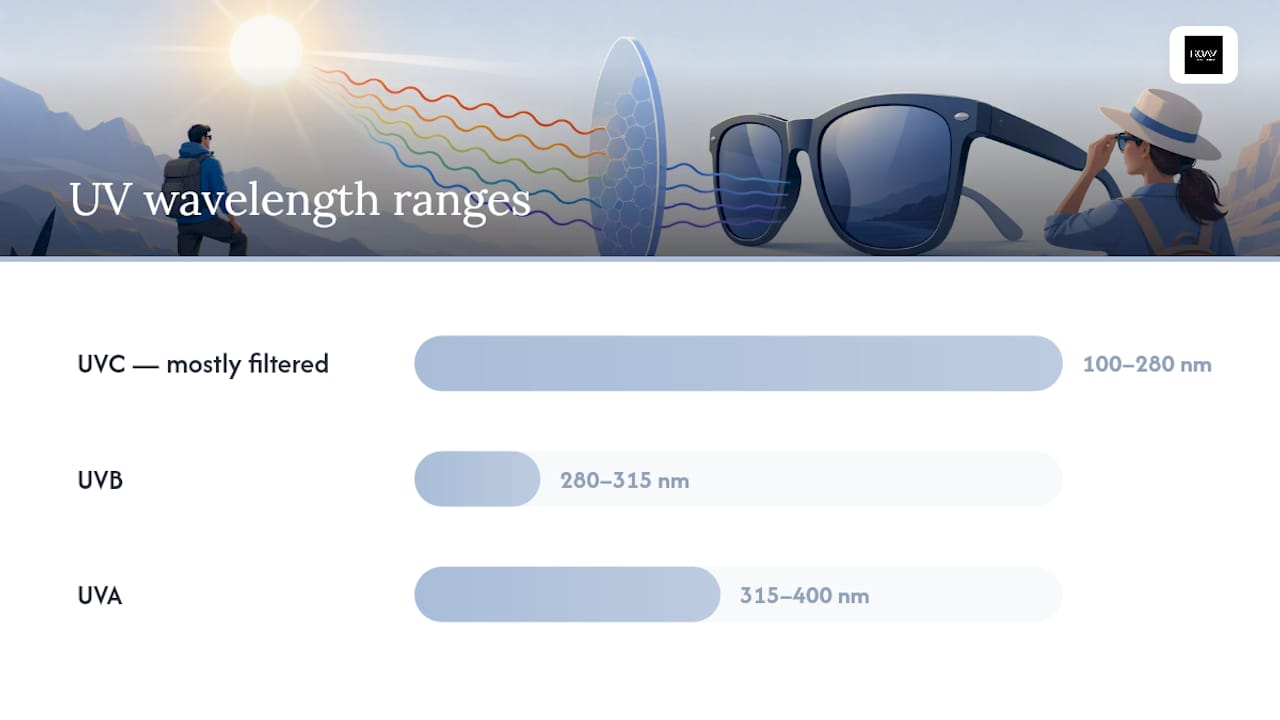
UVA is the band you actually swim in every time you step outside. It makes up the large majority of the UV that hits the surface, and because its wavelength is longer, it penetrates deeper into eye tissue than UVB does. UVB carries more energy per photon and is more biologically aggressive at the surface, which is why it does more damage to the cornea and lens over shorter exposure windows. Both bands top out around 400 nanometres, and that’s the whole logic behind the UV400 cutoff: a lens rated to that number blocks the full working range of ultraviolet light that matters for your eyes, not just a slice of it.
Exposure isn’t flat and predictable. Several factors push it up sharply, including altitude, which increases UV intensity with elevation, making mountain trails and ski runs carry more UV than the same latitude at sea level.
- Reflection: Snow can bounce back a large share of incoming UV, and water reflects a meaningful amount too, which is why snow blindness and beach glare are real phenomena.
- Cloud cover: Clouds block visible light more effectively than they block UV, so a hazy, overcast sky can still deliver significant UV exposure while feeling comfortably dim.
That last point trips people up constantly. Dim light is not a proxy for low UV.
How does UV exposure damage the eye over time?
Ultraviolet damage to the eye is almost never a single dramatic event. It accumulates, quietly, across decades of ordinary outdoor time: commuting, yard work, walking the dog, one squinty summer after another.
The World Health Organization links prolonged, unprotected UV exposure) to cataracts, pterygium and pinguecula (fleshy growths on the eye’s surface), and ocular melanoma, a rare but serious cancer. UVA, which makes up most of the UV reaching the surface, penetrates deeper into eye tissue than UVB, contributing to lens and retinal changes that build up gradually rather than announcing themselves. Photokeratitis, sometimes called snow blindness, is the acute version of this story: a painful, sunburn-like injury to the cornea from a short but intense dose, often on snow or water.
Children absorb more of this risk than adults do because their lenses are clearer and their pupils let in more light. Because the damage is cumulative, earlier exposure leads to greater long-term risk. The WHO’s guidance on UV radiation frames sunglasses as one layer in a broader strategy including hats, shade, and sunscreen, especially for children and outdoor workers.
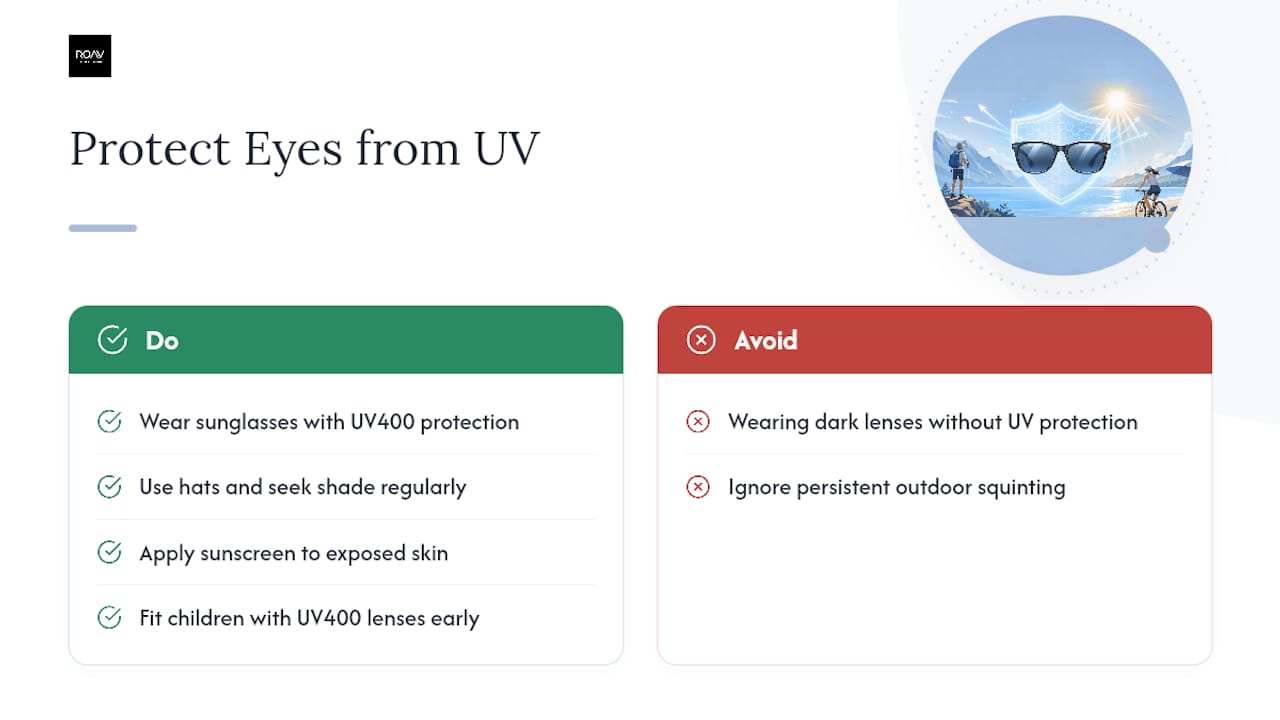
Pro Tip: If your child squints constantly outdoors even on overcast days, that’s often a sign the eyes are struggling with glare and UV, not just brightness. It’s worth getting them into proper UV400 lenses early rather than waiting until they ask for sunglasses themselves.
There’s a counterintuitive risk hiding here too: wearing dark lenses without real UV protection can be worse than wearing none at all, because the eye’s pupil dilates in the dimmer light the dark tint creates, letting in more unfiltered ultraviolet than it would in full daylight with a squint. Darkness without filtering is a trap.
UV400 vs. “100% UV” and “UV380”: which label actually protects you?
UV400 blocks wavelengths up to 400 nanometres, full stop. That number was chosen because it covers the complete UVA and UVB range, leaving no biologically relevant gap. When a lens is genuinely UV400 rated, you can expect it to block more than 99% of incoming ultraviolet in that range, a standard consistent with the guidance public-health bodies point to when recommending sunglasses.
“UV380” sounds close, but a 20 nanometre gap at the upper end of the UVA band is not trivial. Lenses cut off at 380 nanometres let through a slice of longer-wavelength UVA that a true UV400 lens would stop. If you’re comparing two pairs of sunglasses and one says UV400 while the other says UV380, they are not equivalent products with different marketing.
“100% UV protection” is the vaguer claim of the three. It sounds absolute, but without a wavelength attached, it’s not clear whether that 100% covers UVB only, UVA only, or both up to 400 nanometres. Reputable brands that mean UV400 will usually say so explicitly, because it’s the more precise and more useful claim. Public-health guidance consistently favours sunglasses labelled ‘100% UVA/UVB protection’ or ‘UV400’ over vaguer wording, precisely because tint and polarization on their own prove nothing about ultraviolet filtering.
The practical takeaway: when you see UV400 explicitly stated, you’re looking at the clearest, least ambiguous protection claim available on a sunglasses label.
How lens materials and coatings actually block UV
UV blocking happens at the material level, before any tint or coating gets applied, and that’s the part most shoppers never see explained.
Polycarbonate, the plastic used in most modern sunglass lenses, absorbs ultraviolet light as an inherent property of the material itself. A clear polycarbonate lens straight off the production line already blocks a large share of UV, no additive required. That’s a big part of why polycarbonate dominates sport and kids’ eyewear: impact resistance and built-in UV absorption in one material.
Other materials work differently:
- CR-39 plastic: usually needs an added UV-blocking treatment applied during or after manufacturing to reach UV400 performance.
- Glass lenses: also typically require a coating, since untreated glass lets meaningful UV through despite feeling “solid” and protective.
- Photochromic lenses: the tint-shifting reaction is triggered by UV light, but that reaction is separate from whether the lens actually blocks UV from reaching your eye. One does not guarantee the other.
Polarization sits in its own category entirely. It reduces glare by filtering light waves oriented in a particular direction, which is fantastic for cutting reflection off water or pavement, but it does nothing inherent to stop ultraviolet wavelengths. A polarized lens with no UV treatment offers zero meaningful UV protection despite feeling like premium eyewear. If you want to understand that distinction in more depth, it’s worth reading through how UV protection differs from polarization before assuming one implies the other.
This matters just as much for prescription glasses. Clear lenses are not automatically UV400 rated, and opticians caution that consumers need to actively request UV400 treatment on prescription orders rather than assume it’s included by default.
How to actually verify a pair of sunglasses is UV400
Reading a hangtag isn’t enough on its own, but it’s the right place to start, followed by a few checks that take less than a minute in-store.
- Read the label carefully. Look for explicit phrases: “UV400,” “blocks up to 400 nm,” or “100% UVA/UVB protection.” Vague wording like “UV protective” with no specifics is a weaker claim.
- Ask for testing or documentation. A handheld UV transmission meter can measure exactly how much UV a finished lens blocks, and any optician’s shop should either have one or be able to point you to manufacturer certification.
- Treat missing labels as a red flag. No UV rating printed anywhere on the packaging or frame usually means no one has tested or is willing to guarantee the lens’s performance.
- Be skeptical of novelty and fashion sellers. Street vendors, dollar-store racks, and unbranded online listings frequently skip UV testing entirely, even when the lenses are dark or mirrored.
- Never judge protection by tint or price alone. A cheap clear lens can be fully UV400 rated, and an expensive dark pair can offer none, since darkness and cost are not proxies for filtration.
If a retailer can’t answer a direct question about UV rating, that’s information in itself.
Choosing and wearing sunglasses for real UV protection
Lens rating is only half the equation. Fit and frame shape determine how much UV actually reaches your eyes from angles the lens itself never covers.
- Go wraparound or oversized where you can. Standard-width frames leave gaps at the temples that let UV in sideways, especially in bright, open conditions. A wider wrap or a larger lens closes that gap.
- Pair sunglasses with a brimmed hat. A hat blocks overhead and downward UV that even a well-fitted lens can miss, and the combination is more effective than either alone.
- Start kids early, and prioritize fit. Children’s eyes let in more light and absorb more cumulative UV over their lifetime risk window, so proper, well-fitted UV400 lenses matter as much for a six-year-old as for an adult, if not more. Sun protection for kids extends beyond eyewear too. Groups focused on children’s sun safety, like Doll House’s guidance on UPF swimwear, point out that layered protection, hats, UPF fabric, and UV-blocking lenses together, works better than relying on any single product.
- Raise your guard near snow and water. Reflective surfaces can bounce back a large share of incoming UV, meaning glare off snow or a lake adds exposure on top of direct sunlight, not instead of it.
- Match lens category to brightness, not just style. Very bright, high-reflection environments call for darker Category 3 or 4 lenses, but confirm the UV rating is intact at that darkness level rather than assuming darker always means better protected.
If you’re building out a travel or outdoor kit, it’s worth reviewing advice on choosing premium travel sunglasses so fit and portability don’t get sacrificed for style.
Where ROAV Eyewear fits if you want verified UV400 protection
Once you know what to check for, the shopping part gets simpler. ROAV Eyewear builds its sunglasses around a patented micro hinge that folds frames down to a compact, pocket-sized form, a detail that matters most once you’re actually trying to pack for a trip rather than reading about UV bands. The lineup includes options across a few different use cases:
- VIRGIL Black | Silver Mirror: a mirrored lens built for travel, where a compact fold and a reflective finish suit long days moving between airports, cities, and bright outdoor stops.
- INGRID Black | Blue-Gradient: a gradient tint aimed at everyday style, for readers who want fashion-forward eyewear that still folds down small.
- RIVIERA Black | G15: a classic G15 lens tuned for general, everyday wear, a balanced option if you want one reliable pair for most situations.
They have built up a customer base around that fold-and-go design, alongside a lightweight build that avoids the bulk of standard frames. None of that convenience matters if the lens doesn’t actually block UV, so the same rule from earlier in this piece applies here too: check the label, and if you’re ordering prescription lenses, ask directly about UV400 treatment rather than assuming it. If light sensitivity is part of your decision, it’s worth reading through sunglasses advice for sensitive eyes before settling on a tint.
Why most people are asking the wrong question about sunglasses
Most buying advice starts with style and works backward to protection, if it gets there at all. That’s the wrong order. The research here points to a much narrower question that actually matters: does this lens block up to 400 nanometres, and can you prove it?
The conventional wisdom, that dark equals protected, is not just imprecise, it’s occasionally dangerous, because a dark lens with no UV treatment can let more ultraviolet reach a dilated pupil than no sunglasses at all. That single fact should reorder how anyone shops for eyewear. Tint is an aesthetic choice. Polarization is a glare choice. UV400 is the health choice, and it’s the only one of the three you cannot verify by looking at the lens.
If I had to leave a reader with one instruction, it would be this: stop trusting darkness as a signal, and start asking sellers a direct question about wavelength blocking. A retailer who can’t answer that question plainly hasn’t earned your money, regardless of how good the frames look.
— Thomas
Get UV400 protection without carrying a bulky case
Verified UV400 protection shouldn’t force a trade-off with how your sunglasses travel. ROAV Eyewear’s patented micro hinge folds every frame down to a slim, pocket-ready size, so the same lens that blocks ultraviolet up to 400 nanometres also fits in a jacket pocket or a laptop sleeve instead of a rigid case taking up bag space.
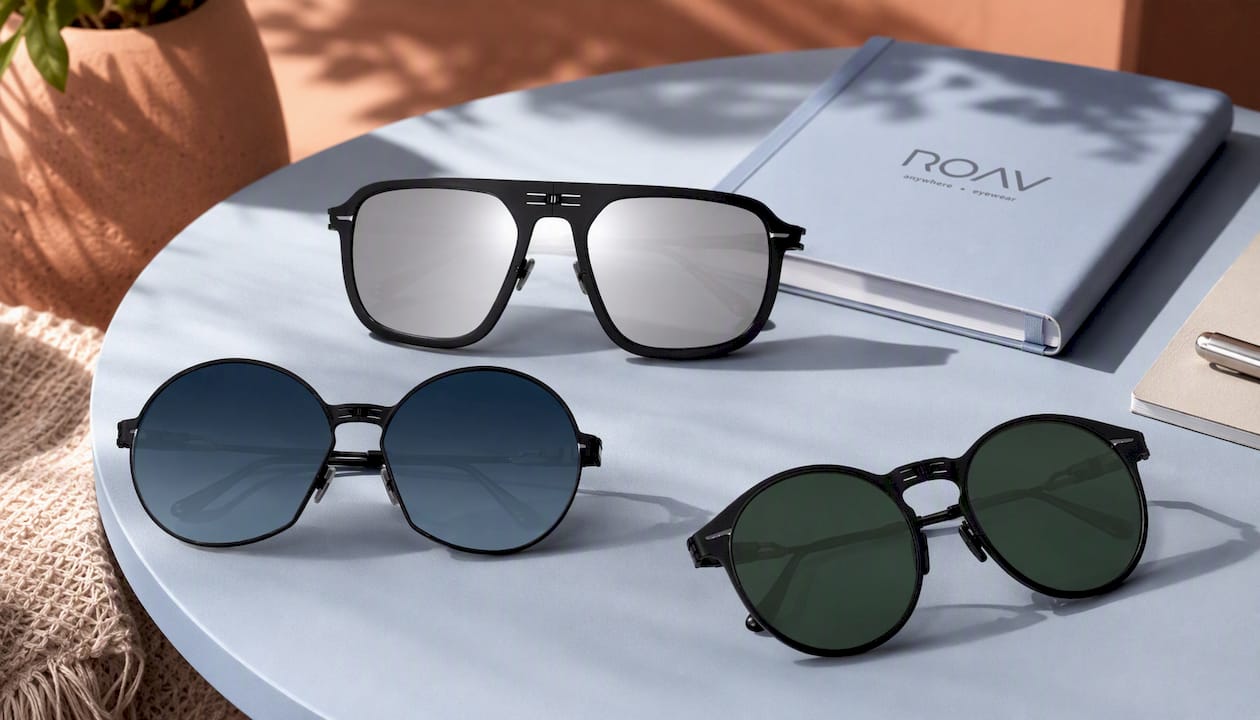
For everyday wear with a neutral, classic tint, the RIVIERA Black | G15 is a solid starting point. If travel is the priority, the VIRGIL Black | Silver Mirror pairs a reflective finish with the same fold-flat convenience. And for a fashion-forward gradient tint that still packs down small, there’s the INGRID Black | Blue-Gradient. Every pair is built with UV protection as standard, not an upsell, so browse the lineup and pick the frame that matches how you actually move through your day.
This article is general information, not a substitute for advice from a qualified doctor. Consult a qualified healthcare professional about your own circumstances before acting on anything here.