

For most people who wear corrective lenses, yes. Prescription sunglasses are worth it if you spend real time outdoors, drive often, or squint through non-prescription shades over your regular glasses. The deciding factor isn’t the frame price. It’s whether the lenses deliver 100% UV protection, the standard optometrists recommend and the one ROAV Eyewear builds into every pair. Read on before you buy.
TL;DR:
- UV protection rated UV400 is essential for prescription sunglasses, as it blocks 100% of UVA and UVB rays regardless of lens tint.
- Polarized lenses significantly reduce glare from water, snow, and roads, which improves safety and comfort while driving or engaging in outdoor activities.
- For frequent outdoor use, strong prescriptions, or active lifestyles, investing in a dedicated pair generally offers better protection and convenience than clip-ons or photochromic lenses.
- The actual quality of UV protection depends on the lens label or a photometer test, making it crucial to verify protection directly rather than rely on tint darkness or price.
- Buying glasses with a current prescription, confirming UV400 protection, and selecting frames that fully cover the eyes ensures maximum value and long-term eye health benefits.
Table of Contents
- Are prescription sunglasses worth it? The real benefits
- What are the real drawbacks and is the cost worth it?
- Which lens features actually matter?
- Who actually benefits most from prescription sunglasses?
- How to buy prescription sunglasses without wasting money
- Does ROAV Eyewear deliver on these buying criteria?
- Clip-ons, fit-overs, and photochromic lenses: how do they compare?
- How do you verify your lenses actually block UV?
- What actually determines value here
- Ready to choose your pair? Here’s where ROAV fits in
- Sources
Are prescription sunglasses worth it? The real benefits
Prescription sunglasses solve a problem clip-ons and cheap drugstore shades can’t: they correct your vision and block ultraviolet light at the same time. That combination matters more than most people realize. UV exposure accumulates over decades, and the American Academy of Ophthalmology links long-term exposure to cataracts and macular degeneration, two of the leading causes of vision loss later in life. A lens rated UV400, or one that blocks 100% of UVA and UVB rays, cuts that risk regardless of how dark the tint looks.
UV400 means full-spectrum protection. Tint darkness has nothing to do with it. A lens can look nearly clear and still block 100% UV, or look pitch black and block almost none.
The practical wins stack up fast:
- Reduced glare on the road and water. Polarized lenses filter reflected light, which is why the National Eye Institute flags them as a genuine driving and boating safety feature, not just a comfort upgrade.
- Fewer headaches from squinting. Constant eye strain in bright light is a common headache trigger, and correcting your vision while blocking glare removes two stressors at once.
- No juggling two vision systems. You’re not swapping between blurry sunglasses and clear-but-unprotected glasses.
- Better outdoor participation. People skip hikes, patio lunches, and afternoon drives when the light bothers them enough. Comfortable eyes mean you actually do the thing.
Skipping this step doesn’t make the sun go away. It just means your eyes absorb more of it while you squint through a workaround.
What are the real drawbacks and is the cost worth it?
Prescription sunglasses cost more upfront than a $20 pair of sunglasses or a $40 clip-on attachment, and that’s the honest trade-off. You’re also carrying two pairs of glasses, which raises the odds of leaving one behind at a restaurant or losing a frame at the beach. If your prescription changes yearly, you’re paying for new lenses twice as often.
Here’s how to think through the math:
- Add up clip-on replacement costs. Clip-ons crack, scratch, and get lost relatively frequently, that cost stacks up quietly, per the AAO’s guidance on weighing prescription sunglass costs.
- Amortize over the pair’s realistic lifespan. A $150 to $250 prescription pair used two to three seasons a year works out to well under a dollar a day.
- Ask about bundle pricing. Many clinics and retailers discount a second lens set when purchased alongside your regular glasses.
- Consider photochromic lenses instead if you split time evenly between indoors and outdoors and don’t want two pairs at all.
If you wear glasses outdoors only occasionally, a quality clip-on may genuinely be the better value.
Which lens features actually matter?
Not every lens upgrade earns its price tag, and confusing them wastes money on the wrong feature. UV protection, polarization, and tint darkness are three separate things, and only one of them is non-negotiable.
- UV protection blocks the wavelengths tied to cataracts and macular degeneration. This is the feature you never compromise on, per Johns Hopkins Medicine.
- Polarization cuts reflected glare off water, snow, and pavement. It improves comfort and driving safety but doesn’t add UV blocking on its own.
- Tint darkness is cosmetic. A dark lens with no UV coating protects you less than a light lens rated UV400.
- Photochromic (transition) lenses adjust to light automatically, convenient for errands, but they lag behind actual sunlight intensity and don’t darken properly behind a car windshield, making them a poor primary choice for driving.
On materials: polycarbonate and Trivex are lighter and impact-resistant, a smart pick for sports or outdoor work. High-index lenses keep strong prescriptions from turning into thick, heavy edges. Glass offers the sharpest optical clarity but adds weight and shatter risk.
Pro Tip: If you’re deciding between two similar pairs, check anti-reflective and scratch-resistant coatings before you check colour options. Coatings affect daily comfort far more than frame finish.
You can compare UV blocking versus polarization in more detail if you want the full breakdown before choosing lenses.
Who actually benefits most from prescription sunglasses?
Some glasses wearers get far more value out of a dedicated sun pair than others, and knowing which group you fall into makes the decision easier.
- Frequent drivers. Polarized, UV-blocking lenses cut glare from wet roads and low sun angles, a real safety factor rather than a comfort feature.
- Outdoor athletes and water or snow sport enthusiasts. Reflected glare off snow and water intensifies UV exposure, and Optometry Canada recommends year-round sun protection for exactly this reason.
- Strong prescriptions or progressives. Clip-ons distort peripheral vision on high prescriptions; a purpose-built lens avoids that entirely.
- Frequent travellers. A foldable, compact frame offers convenience compared to carrying a bulky case and separate glasses
- Outdoor workers and people with light sensitivity. Daily, sustained UV exposure makes protection a health need, not a style choice.
If you recognize yourself in two or more of these, the cost-per-wear math tips firmly in favour of buying a dedicated pair.
How to buy prescription sunglasses without wasting money
Buying prescription sunwear well comes down to sequencing. Skip a step and you either overpay or end up with lenses that don’t fit your life.
- Get a current prescription and PD (pupillary distance) measurement. An outdated prescription wastes the whole purchase.
- Confirm UV400 or 100% UV protection in writing, not just implied by a dark tint.
- Choose a frame size that covers your eyes fully, including the sides, for meaningfully better protection.
- Test polarized versus non-polarized samples if you’re unsure which suits your daily routine.
- Add high-index lenses for strong prescriptions and prioritize anti-reflective and scratch coatings over cosmetic add-ons.
- Compare total pricing across retailers, and ask about warranties or FSA/insurance eligibility before finalizing.
| Step | Why it matters | What to ask for |
|---|---|---|
| Prescription check | Avoid paying for lenses that need redoing | Current script, PD measurement |
| UV verification | Confirms real protection, not just tint | UV400 label or photometer test |
| Frame fit | Wraparound coverage blocks more peripheral light | Larger or curved frame options |
| Lens material | Affects weight, durability, and clarity | Polycarbonate, Trivex, or high-index |
| Coatings | Improves daily comfort and lens lifespan | Anti-reflective, scratch-resistant |
Does ROAV Eyewear deliver on these buying criteria?
Roaveyewear built its entire product line around the exact friction points this guide covers: fragile frames, bulky cases, and shades that get left behind because they’re a hassle to carry. The patented micro hinge folding mechanism collapses full-size frames into a pocket-sized profile, solving the “two pairs of glasses” problem that makes prescription sunwear feel inconvenient in the first place.
More than 100,000 customers have bought into that practicality, citing durability and UV protection as the main reasons they stuck with the brand.
- Screwless, ultra-durable frame construction built to handle daily folding and travel.
- UV protection built into the lens, not treated as a paid add-on.
- Multiple frame styles suited to different face shapes and prescriptions.
- A compact carry case included with every pair, addressing the “left it on the plane” problem directly.
Clip-ons, fit-overs, and photochromic lenses: how do they compare?
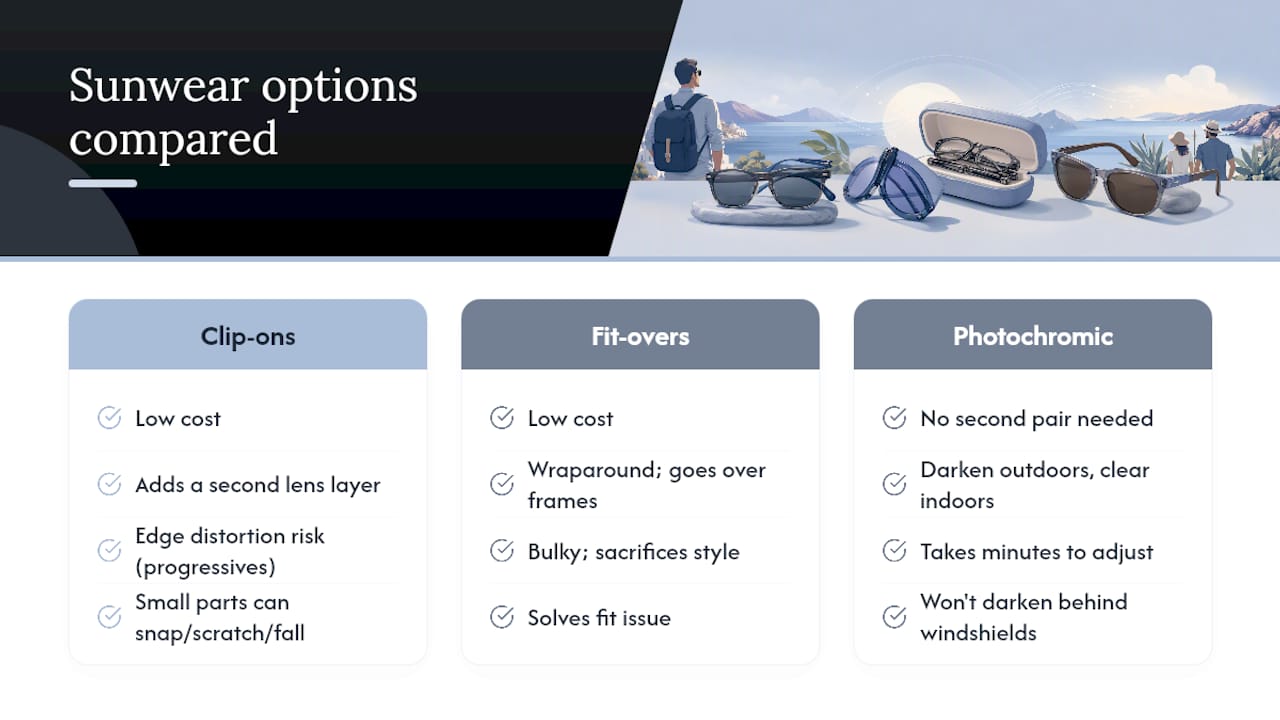
Clip-ons and fit-overs solve the sun problem cheaply, but they come with compromises a dedicated prescription pair doesn’t. A clip-on adds a second lens layer in front of your existing glasses, which can introduce distortion at the edges, especially with progressive lenses, and it’s one more small part that can snap, scratch, or fall off. Fit-over sunglasses (the larger wraparound style that goes over your regular frames) solve the fit issue but sacrifice style and often feel bulky for daily wear.
Photochromic, or transition, lenses eliminate the two-pairs problem entirely by darkening in sunlight and clearing indoors. They work well for errands, walking the dog, or moving between rooms and a patio. The trade-off shows up in two places: they take a few minutes to fully adjust in either direction, and most photochromic lenses don’t darken properly behind a car windshield because the UV that triggers the reaction is blocked by the glass. That makes them a weak primary choice for anyone who drives regularly in bright conditions.
A dedicated prescription sunglass pair avoids all three compromises. There’s no distortion, no lag, and no windshield blind spot. The cost is carrying a second pair, but for the use cases where clip-ons and photochromics fall short, that trade-off is exactly what you’re paying to solve.
How do you verify your lenses actually block UV?
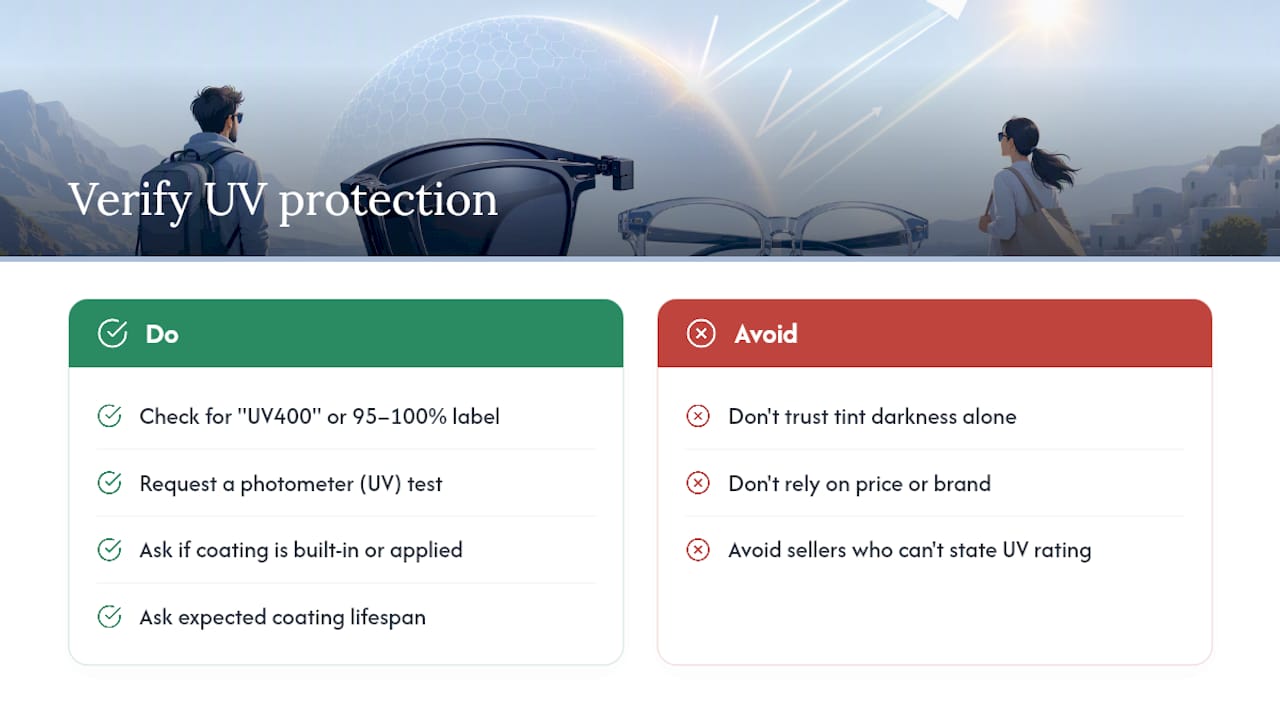
Don’t trust tint darkness, price, or brand reputation alone. The only reliable indicators are a UV400 label, a stated 95 to 100% UV protection claim, or a direct test.
Look for the label first. Reputable lenses state UV400 or a specific UVA/UVB percentage on the packaging or invoice. If that information isn’t listed, or you’re buying secondhand or from an unfamiliar retailer, ask for a photometer check. Many optical shops and eye-care clinics have a photometer on hand, and Johns Hopkins Medicine points to this as the most reliable way to confirm protection when a label is missing or unclear. The test takes a couple of minutes and gives you a definitive answer rather than a guess based on how dark the lens looks.
If you’re getting prescription lenses made to order, ask your optometrist directly whether the UV coating is built into the lens material (polycarbonate has it inherently) or applied as a separate treatment. Some coatings degrade faster than others, so ask about expected lifespan too, particularly if you’re outdoors daily. When in doubt, buy from a retailer or optical shop willing to answer these questions directly instead of pointing you to a marketing page. A retailer that can’t tell you their UV rating on request is a red flag worth taking seriously.
What actually determines value here
The conventional advice treats prescription sunglasses like a luxury upgrade, something you buy once you’ve already covered the “necessities.” That framing gets it backwards. Cataracts and macular degeneration develop from cumulative exposure over decades, which means the protective value of a good pair compounds the same way the risk does. Buying at 30 pays off more than buying at 60.
Where most guides fall short is treating price as a proxy for quality. It isn’t. A $400 frame with a poor UV coating protects you less than a $150 pair labelled UV400. The frame is fashion. The lens rating is the actual product.
If you take one thing from this, prioritize the UV400 label over every other decision, then work backwards to fit, polarization, and style. Get the lens right first. Everything else, including how the frame folds into your bag, is a convenience layer on top of that foundation, and a genuinely useful one once the fundamentals are covered.
— Ghali
Ready to choose your pair? Here’s where ROAV fits in
Once UV400 protection is confirmed, the decision comes down to fit and how the pair fits your actual life, not just your face. Roaveyewear’s foldable, screwless frames solve the part most prescription sunglasses ignore: what happens to them between wears.
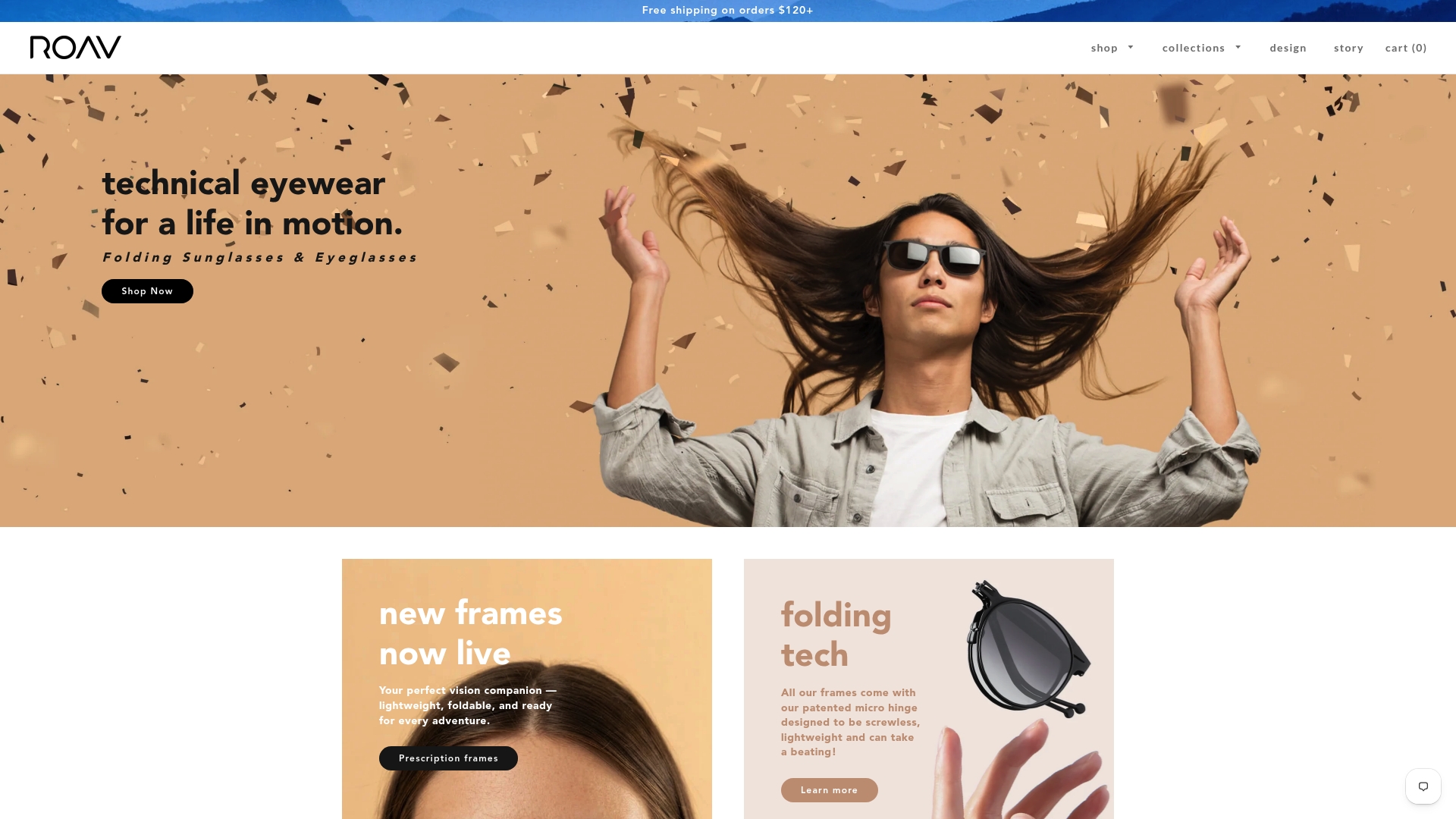
The SIERRA Gunmetal+Black | Clear suits anyone who wants a neutral, everyday frame that folds flat for a bag or glovebox. The SIERRA Gold+Havana | Clear offers the same foldable construction in a warmer tortoise-and-gold finish, better suited to lighter skin tones and casual wear. For a classic sunglass look with a true G15 tint, the PRESLEY Gold | G15 delivers polarized glare reduction in a shape that works across most face widths.
All three ship with a compact case, so the “left my sunglasses on the plane” problem this guide covers becomes far less likely. Check current warranty terms and FSA eligibility at checkout, then browse the full prescription sunglasses lineup to find the frame that fits your prescription and your travel habits.
Sources
- Taking a clear look at prescription sunglasses — American Academy of Ophthalmology
- How to select the best sunglasses — Optometry Canada
- How sunglasses help protect your eyes — Johns Hopkins Medicine
- Protecting your eyes from the sun’s UV light — NEI