

Trivex wins on optical clarity and comfort. Polycarbonate wins on cost and blunt-impact margin. If you need the sharpest, lightest vision, especially in a rimless frame, choose Trivex. If you need the toughest budget option, especially for kids or sports, polycarbonate remains the safer default. Both meet ANSI Z87.1 impact standards, and frames from foldable eyewear brands work with either.
TL;DR:
- Polycarbonate lenses typically cost less, are more widely available, and excel in blunt-impact scenarios for high-risk activities or children’s sports.
- Trivex offers superior optical clarity with a higher Abbe value, reducing color fringing especially in higher prescriptions or for progressive lens wearers.
- Both materials meet safety standards, but Trivex has a higher tensile strength and better post-impact clarity, making it preferable for drilled or rimless frames.
- The choice depends on your prescription, frame style, and specific safety needs, with Trivex being more suitable for higher prescriptions and rimless designs.
- Ask your lab for actual thickness and weight calculations before choosing, as frame size and edging can influence the final product’s comfort and durability.
Table of Contents
- Polycarbonate vs Trivex lenses: quick comparison
- How does optical clarity differ between the two materials?
- Which material is safer for kids, sports, and daily wear?
- How do thickness, weight, and cost trade off?
- How do you decide which lens material is right for you?
- Where ROAV Eyewear fits in the material decision
- What actually matters when you’re choosing between these two lenses
- Ready to pair your lenses with the right frame?
- Sources
Polycarbonate vs Trivex lenses: quick comparison
The two materials look similar on a lens edger but behave differently once they’re in a frame. Here’s where the numbers actually diverge.
- Optical clarity (Abbe value): Trivex measures 43 to 45; polycarbonate sits around 30. Higher is better for reducing colour fringing.
- Specific gravity (weight): Trivex is about 1.11 g/cm³, polycarbonate about 1.20 g/cm³, so Trivex is the lighter of the two materials.
- UV protection: Both block 100% of UVA and UVB inherently, with no added coating required.
- Impact resistance: Both exceed ANSI Z87.1 and FDA drop-ball requirements, roughly ten times tougher than standard CR-39 plastic.
- Cost and availability: Polycarbonate is cheaper and stocked in nearly every lab; Trivex costs more and ships from fewer suppliers.
Pro Tip: If you’re comparing two quotes and one lens is noticeably cheaper, ask whether it’s polycarbonate. That price gap usually comes down to material, not workmanship.
For parents outfitting a kid who plays contact sports, polycarbonate’s price and toughness make it the practical pick. For someone getting rimless frames or a first pair of progressives, Trivex’s clarity is worth the extra cost.
How does optical clarity differ between the two materials?
Abbe value measures how much a lens material bends different wavelengths of light unevenly, which shows up as colour fringing at the edges of your vision. Trivex’s Abbe value of 43 to 45 outperforms polycarbonate’s roughly 30, and that gap is not just a spec sheet number. It’s the difference most wearers actually notice in real-world use, particularly in peripheral vision and with progressive lenses, where the lens power shifts continuously across the surface.
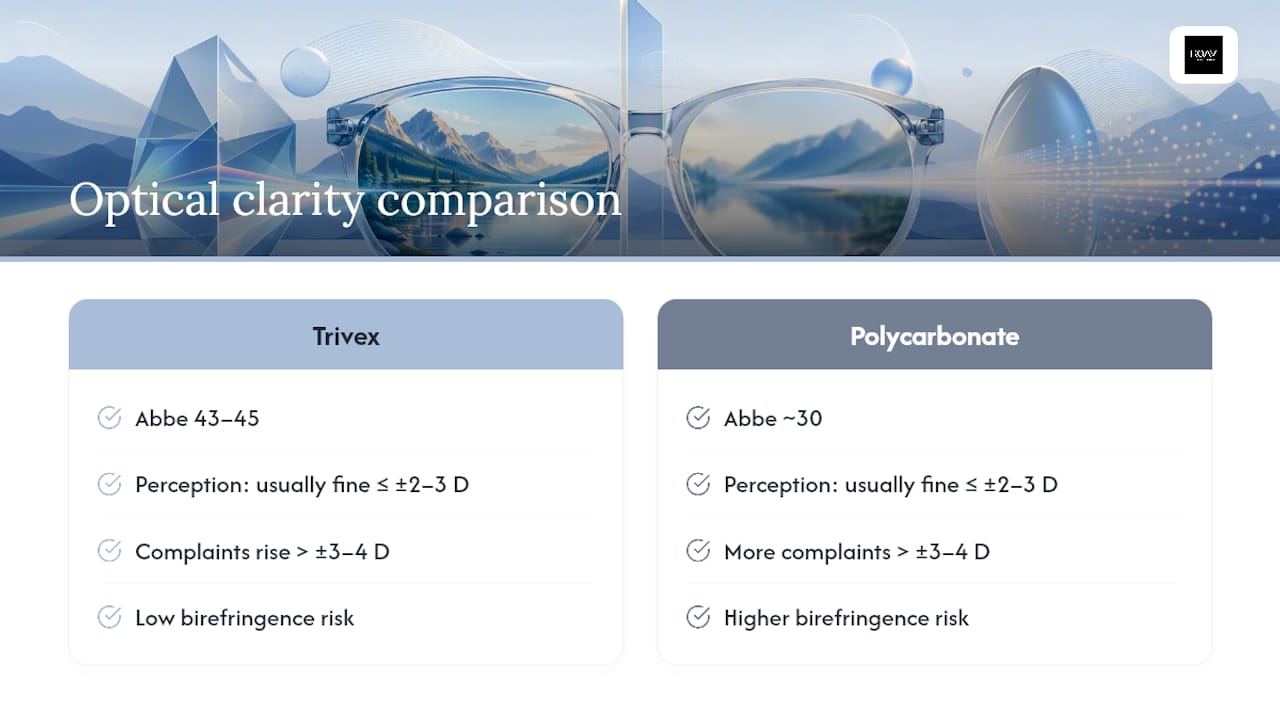
Whether you’ll perceive it depends heavily on your prescription. Under roughly ±2.00 to ±3.00 dioptres, polycarbonate’s lower Abbe value is unlikely to bother you. Push past ±3.00 to ±4.00 D, and chromatic aberration complaints become more common, especially toward the edge of the lens.
There’s a second, less discussed issue: birefringence. Polycarbonate is more prone to internal stress during moulding, which can create faint striations or double-vision artifacts under certain lighting. Trivex, cast rather than injection-moulded, tends to hold its optical structure more evenly. High-cylinder astigmatism patients and long-time progressive wearers are the two groups most likely to notice this, and the ones most likely to ask for Trivex by name once they’ve tried it.
Which material is safer for kids, sports, and daily wear?
Safety-wise, you can’t go wrong with either material on paper. Both polycarbonate and Trivex clear ANSI Z87.1 and FDA drop-ball impact testing, the two benchmarks labs use to certify safety and sport eyewear. Where they part ways is at the margins, not the minimums.
- Polycarbonate tends to show a higher blunt-impact ceiling, resisting higher-velocity strikes before failing in some lab configurations.
- Trivex tends to show less surface dimpling and better post-impact clarity, meaning it stays clearer after a hit rather than just surviving the hit.
- Trivex measures roughly 61.2 kgf in tensile strength testing versus about 44.9 kgf for polycarbonate, which matters most for drilled or rimless mounts.
- Manufacturer-run tests, including PPG’s own data, have reported Trivex outperforming polycarbonate on combined impact, clarity, and chemical resistance in certain trial setups.
Pro Tip: If your frame has no rim and holes are drilled directly into the lens, ask specifically for Trivex. Its tensile strength resists cracking around the drill points far better than polycarbonate.
For a nine-year-old’s first pair or an industrial safety application, polycarbonate’s proven blunt-impact margin and lower cost still make it the sensible default.
How do thickness, weight, and cost trade off?
Two numbers decide how thick and heavy your finished lenses turn out: refractive index and specific gravity. A higher index bends light more efficiently, allowing a thinner lens for the same prescription. Specific gravity determines how much that lens weighs once it’s cut to size. Trivex and polycarbonate sit close in index (both around 1.53), but Trivex’s lower specific gravity gives it a real, if modest, weight edge in the finished product.
- Low prescription, large frame: thickness barely matters here, so cost usually decides the call, and polycarbonate wins on price.
- High prescription, small frame: both materials will still be thicker than a high-index alternative; Trivex’s clarity edge starts paying off more here.
- Rimless or drill-mount styles: Trivex’s added tensile strength justifies its premium.
One caution worth repeating: don’t assume Trivex is always lighter in the finished pair. Frame eye size and edge thickness can flip the expected weight difference, so ask your lab for an actual thickness calculation rather than trusting the spec sheet alone. Expect to pay a moderate premium for Trivex, and expect it to be less widely stocked than polycarbonate at smaller labs.
How do you decide which lens material is right for you?
Match your priorities to the material in three steps, not one gut call at the counter.
- Identify your primary risk. Contact sports, jobsite work, or a child who breaks glasses twice a year points toward polycarbonate’s blunt-impact margin.
- Check your prescription strength. Anything past ±3.00 to ±4.00 D pushes you toward Trivex for the Abbe value alone.
- Consider your frame style. Rimless or drilled mounts favour Trivex’s higher tensile strength; full-rim styles work fine with either.
Before you commit, ask your optician or lab these questions:
- Does this lens material work with anti-reflective and blue-light coatings I want?
- Will drilling or edging change under warranty if I choose Trivex over polycarbonate?
- Does my vision plan cover one material but not the other?
- What’s your lab’s breakage replacement policy for each option?
A red flag worth noting: if a dispenser can’t tell you the Abbe value or specific gravity of what they’re selling you, that’s a sign to ask more questions before signing off.
Where ROAV Eyewear fits in the material decision
Choosing a lens material only solves half the problem. The frame carrying it needs to hold up the same way, which is where Testing on foldable, screwless frames comes in. Both lens materials perform well in micro hinge foldable frames, since neither relies on the frame’s rim for structural support the way older rimless designs did.
For rimless-style clarity seekers, the DALLAS Black+Crystal | Clear pairs naturally with Trivex given its slim profile. Active wearers who need a tougher daily driver tend to land on the ACE Gunmetal+Crystal | Clear, a solid match for polycarbonate’s impact margin. The DEVON Gunmetal+Crystal | Clear splits the difference for anyone undecided.
What actually matters when you’re choosing between these two lenses
Most guides treat this as a straightforward toughness contest, and that’s where they get it wrong. Polycarbonate’s reputation as “the safety lens” oversells its real advantage, which is narrow and specific: a slightly higher blunt-impact ceiling in lab conditions most wearers will never encounter.
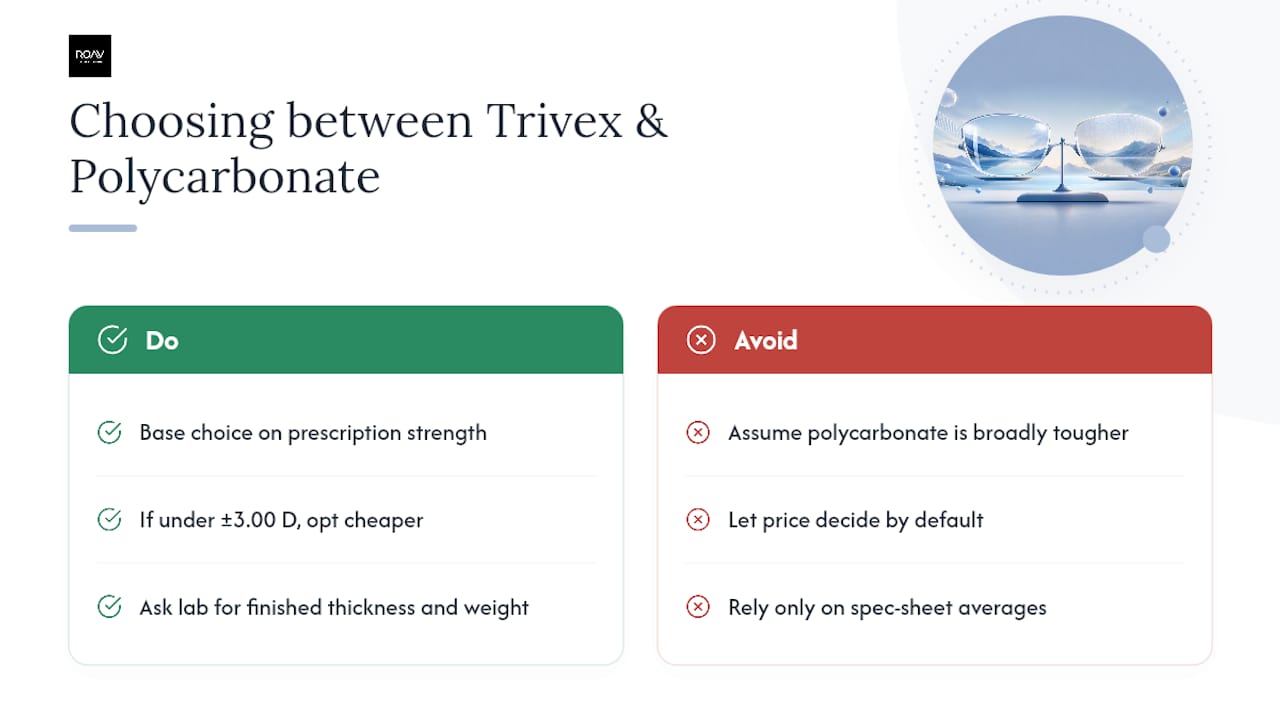
The bigger mistake I see is patients letting price decide by default instead of prescription strength. If you’re under ±3.00 D, sure, save the money. Past that, you’re paying for a wider tolerance to visual noise you’ll notice every time you look sideways through a progressive lens. That’s the trade-off conventional advice glosses over.
My honest read: ask your lab for the finished thickness and weight calculation before you decide, not after. The spec sheet numbers are averages. Your prescription and frame are not.
— Thomas
Ready to pair your lenses with the right frame?
Once you’ve settled on Trivex or polycarbonate, the frame decision is where most people either save money or waste it on something that doesn’t survive daily use. Screwless, micro hinge frames built to fold flat without stressing the lens mount matter whether you’re carrying a rimless Trivex pair or a tougher polycarbonate build.
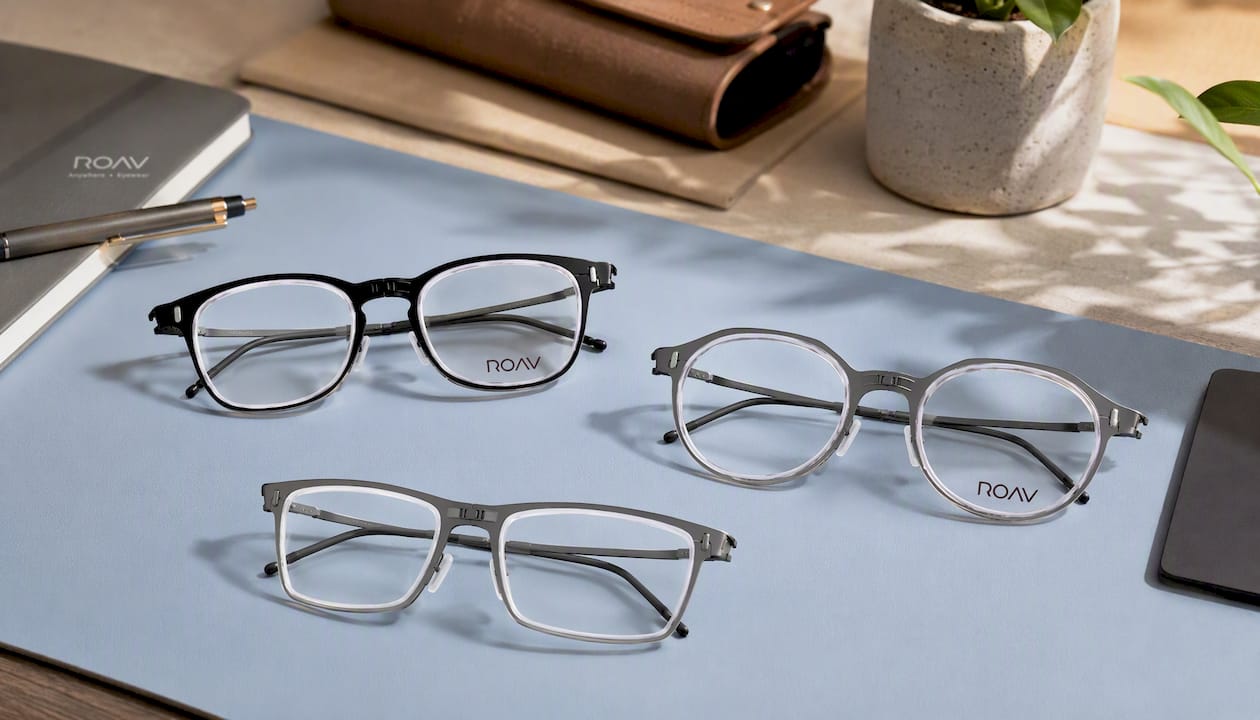
Start by confirming your prescription and drop point with your optician, then pick your lens material based on the priorities above. From there, browse the DALLAS Black+Crystal | Clear for a slim rimless-ready shape, the ACE Gunmetal+Crystal | Clear for a sturdier everyday build, or the DEVON Gunmetal+Crystal | Clear if you want a middle ground. Add either lens material at checkout and request lab mounting, and you’ll have a pair that folds down small enough for a jacket pocket without compromising the prescription work you just chose carefully.