

Standard sunglasses aren’t built to block blue light. Their job is UV protection, and any reduction in blue wavelengths is a side effect of the tint, not a designed feature. Dark tints cut a modest slice of blue light incidentally, while lenses with dedicated blue-filter coatings or chromophores cut far more. That said, the clinical case for needing this protection at all is thin: high-quality research hasn’t shown that routine blue-light exposure causes eye strain or retinal damage in healthy adults. What actually determines a lens’s performance is its transmittance data, not the label on the box.
TL;DR:
- Most sunglasses provide only incidental blue-light reduction, with dark tints blocking typically 15 to 30 percent, not a specific blue-light filtering feature.
- Blue-light filters target the 400 to 455 nanometre band but rarely block more than around 72.5 percent even in lab conditions, and evidence shows minimal clinical benefit.
- UV400-rated lenses block nearly all ultraviolet rays but do not necessarily filter blue light, leading to potential confusion when shopping for blue-light specific protection.
- Polarized lenses address glare from outdoor surfaces but do not affect blue-light transmission or screen-related indoor eye strain.
- Reliable blue-light filtering requires checking for a transmittance spectrum and asking manufacturers for lab data, as marketing claims and labels are often unverified.
Table of Contents
- What is blue light, and how is it different from UV?
- How do tint, coatings, and lens material change blue-light transmission?
- How much blue light do sunglasses actually block?
- Polarized lenses vs. blue-light filters: which one do you need?
- How can you tell if your sunglasses block blue light?
- What does the research actually say about blue-light protection?
- Our take on blue-light claims in eyewear
- Travel-ready sunglasses that don’t skip UV protection
- Sources
- FAQ
What is blue light, and how is it different from UV?
Blue light, sometimes called high-energy visible (HEV) light, sits roughly in the 400 to 500 nanometre range on the visible spectrum, and choosing the right blue light screen protector in the UK can help manage its impact on your devices. Ultraviolet light sits just below that, at wavelengths shorter than 400 nanometres, invisible to the human eye. The two ranges border each other, and that border is exactly where most eyewear marketing gets slippery.
A UV400 rating means a lens blocks essentially all light below 400 nanometres. It says nothing about what happens above that line. A lens can carry a UV400 certification and let almost all blue light pass straight through, because UV400 lenses are designed and tested for the UV band, not the visible one. That gap between “blocks UV” and “blocks blue” is where a lot of confused shopping decisions start, and where a lot of vague marketing language lives.
How do tint, coatings, and lens material change blue-light transmission?
Two different mechanisms are at work here, and they’re easy to mix up. A tint is a dye added to or embedded in the lens that absorbs light across a range of wavelengths, cutting brightness generally. A blue-filter coating or chromophore is engineered specifically to absorb energy in the 400 to 455 nanometre band, leaving the rest of the visible spectrum comparatively untouched.
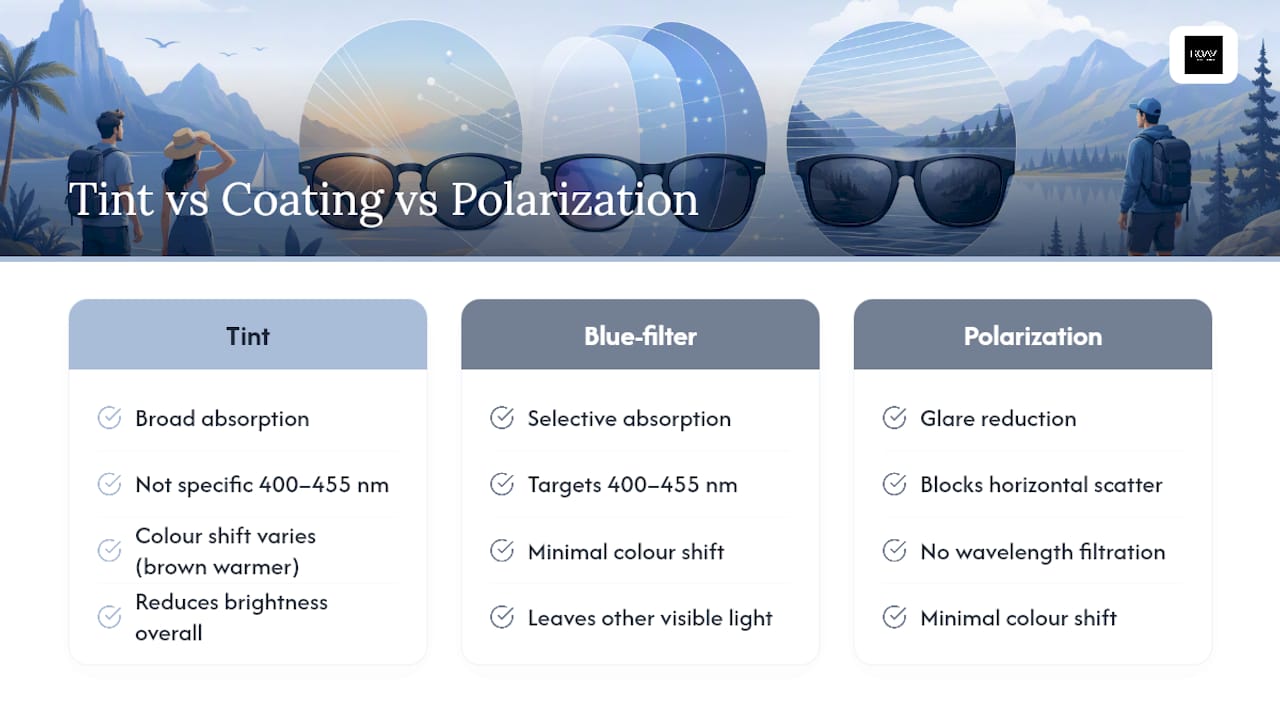
Tint colour matters here. Gray tints reduce brightness evenly with minimal colour distortion. Brown and amber tints skew warmer, and in doing so, they absorb more of the blue end of the spectrum incidentally, which is why some outdoor and shooting glasses lean amber. Polarization is a separate mechanism entirely: it uses a laminated filter to block horizontally scattered light, cutting glare off water, snow, and pavement. It has nothing to do with wavelength filtration, a point worth keeping straight when you’re comparing UV protection and polarized options.
Push any of these filters too hard and you get trade-offs: noticeable colour shift, reduced brightness in low light, and in extreme cases, degraded vision at dusk when your eyes already rely on dim-light sensitivity.
How much blue light do sunglasses actually block?
The numbers vary enormously depending on what you’re wearing, and that’s the part most marketing copy skips.
- Clear UV400 lenses with no tint: minimal reduction in the blue band, since UV400 lenses primarily target wavelengths below 400 nanometres.
- Standard dark-tinted sunglasses: typically 15 to 30% incidental blue-light reduction, according to the American Academy of Ophthalmology.
- Amber or brown tints and dedicated blue-filter lenses: substantially higher attenuation concentrated in the 400 to 455 nanometre band, though the exact figure depends entirely on the dye chemistry and lens material used.
Some limited brand testing has recorded averages as high as 72.5% blue-light blocking for certain tinted sunglasses under specific lab conditions, but that number moved wildly between products and testing methods. This is why a single percentage on a product label tells you almost nothing on its own. A transmittance spectrum, plotted across wavelengths, is the only measure that tells you what a specific lens actually does at 420 nanometres versus 480 nanometres. And even a lens that measurably filters blue light hasn’t been shown to deliver a clinical benefit, a distinction covered further down.
Polarized lenses vs. blue-light filters: which one do you need?
These solve two completely different problems, and confusing them leads to buying the wrong pair. Polarization cuts glare from horizontal surfaces, which is what makes driving, boating, skiing, and beach days genuinely more comfortable. Its downside is that it can occasionally distort the readability of some LCD screens, an issue worth knowing about if you’re constantly checking a phone outdoors.
Blue-light filters target screen-heavy evening use indoors, not outdoor glare, and they do little for sun safety on their own. If you spend your days driving, travelling, or moving between bright outdoor settings, prioritize polarization, as detailed in this breakdown of polarized lens benefits. If your main concern is hours in front of a laptop after dark, a quantified blue-filter lens matters more than polarization ever will.
How can you tell if your sunglasses block blue light?
A quick visual check gives you a hint, not a guarantee. Tilt the lens under a lamp: a faint blue or purple sheen usually signals an anti-reflective or HEV coating is present, since that reflection is a known visual marker of blue-light coatings. UV flashlight tricks and other casual store demonstrations are far less reliable, since they mostly test UV absorption, not blue-wavelength filtration, and can easily mislead you into thinking a lens does more than it does.
Before buying, ask the retailer these questions:
- Can you provide a transmittance spectrum for this lens, not just a summary percentage?
- What is the measured transmission specifically at 420 nanometres?
- Does the coating or tint target the 400 to 455 nanometre band, or is the blue-light reduction incidental to a general tint?
Pro Tip: If a brand can’t produce a transmittance chart on request, treat any blue-light claim on the packaging as unverified. Legitimate lens manufacturers test and document this data, and checking eyewear claims before you buy is worth the extra five minutes.
What does the research actually say about blue-light protection?
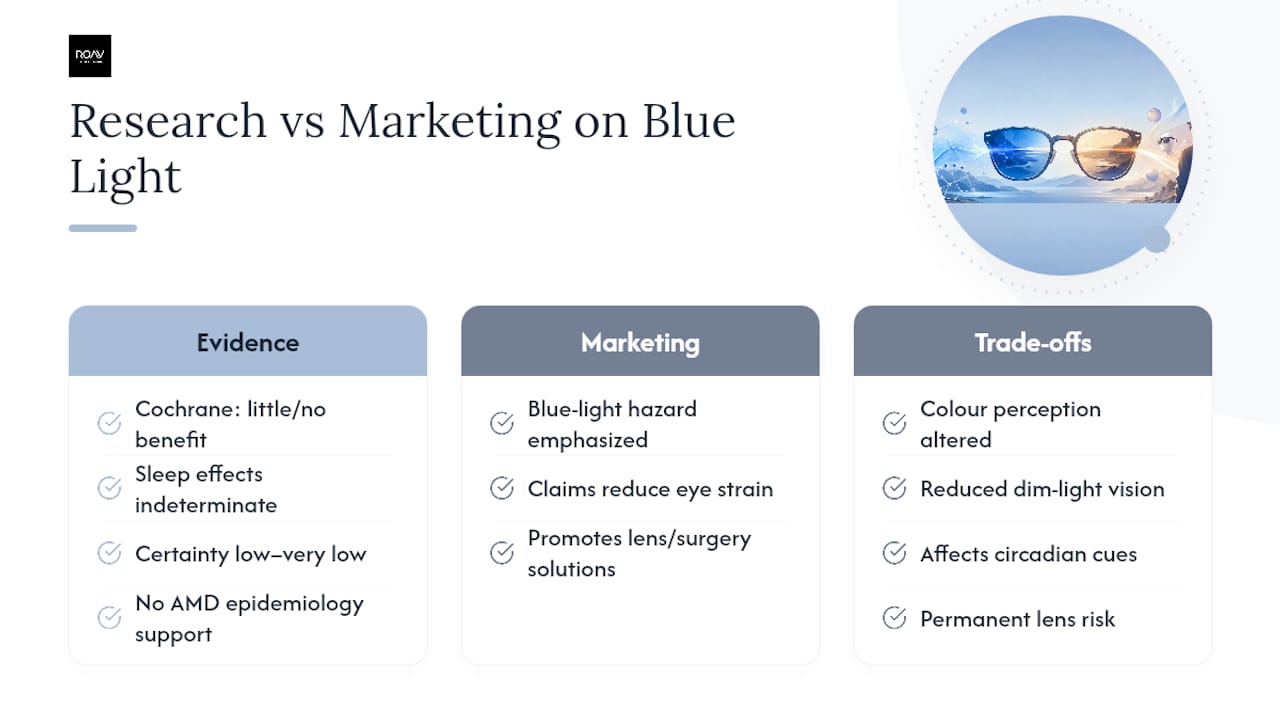
This is where the marketing narrative and the clinical evidence part ways. A Cochrane systematic review found little to no high-quality evidence that blue-light filtering spectacle lenses reduce digital eye strain, and rated the effects on sleep as indeterminate, with the overall certainty of evidence graded low to very low.
Peer-reviewed analyses go further, arguing the “blue-light hazard” premise itself has been overstated. Researchers examining the blue-light hazard versus blue-light hype found no epidemiological support for the claim that ordinary environmental light exposure causes age-related macular degeneration, or that blue-filtering intraocular lenses reduce that risk. The American Academy of Ophthalmology’s position lines up with this: screen-emitted blue light is not considered a major ocular risk compared with sun exposure, and standard sunglasses primarily reduce brightness and UV rather than targeting blue wavelengths specifically.
There’s also a real trade-off worth flagging: blocking blue light too aggressively, particularly through permanent interventions like blue-blocking intraocular lens implants, can distort colour perception and reduce dim-light vision, since blue wavelengths play a genuine role in circadian regulation.
Our take on blue-light claims in eyewear
The blue-light panic has outrun the evidence, and it’s worth saying plainly: most people shopping for sunglasses don’t need to obsess over a blue-light percentage. Prioritize UV400 protection first, always, because sun exposure is the ocular risk with actual clinical backing behind it. Add polarization if you spend real time outdoors in glare, whether that’s driving, hiking, or standing on a boat. Only chase a quantified blue-light attenuation number if your specific concern is hours of evening screen use, and even then, ask for the transmittance data rather than trusting a label.
Foldable frames that include UV400 protection as the baseline, with polarized lens options available across several styles for glare-heavy outdoor use. If a specific model’s blue-light attenuation numbers matter to your decision, contact the manufacturer directly for lab data rather than relying on any general claim, ROAV’s included.
— Thomas
Travel-ready sunglasses that don’t skip UV protection
If UV protection and packability matter more to you than an unproven blue-light percentage, foldable frames designed to fold down to pocket size without sacrificing UV400 protection.
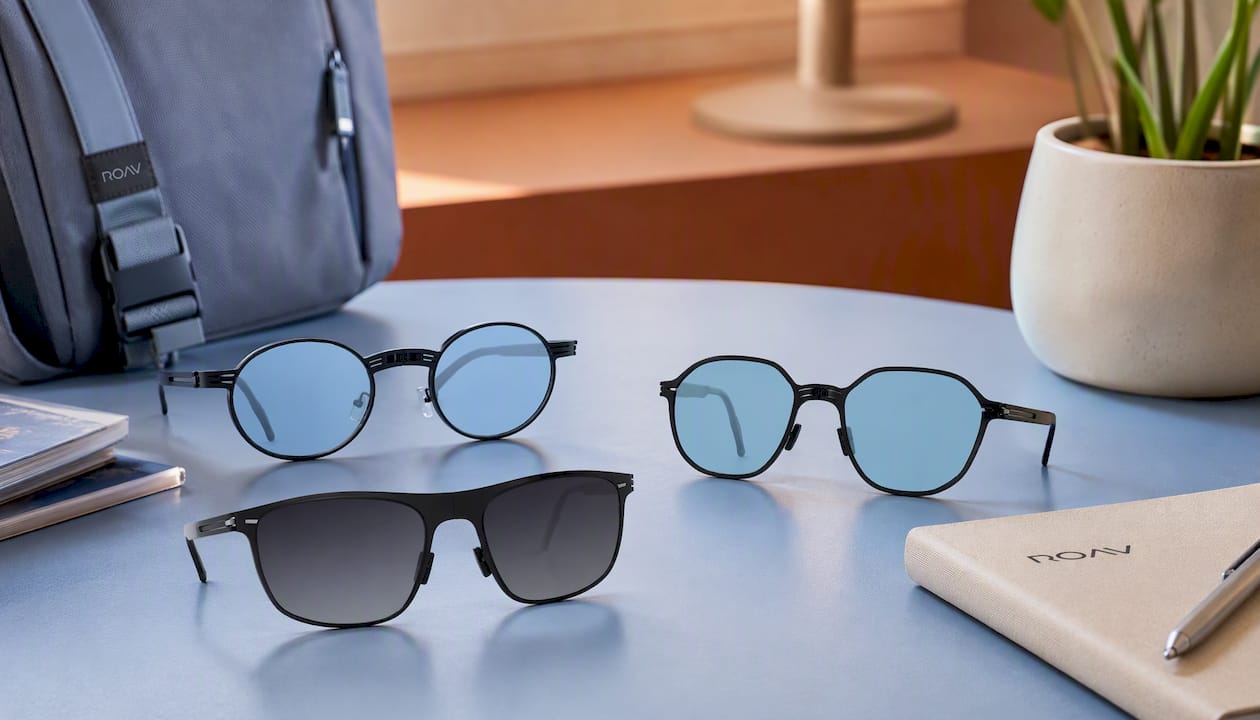
Three current styles show the range: the NESTOR Black | Light-blue and DEAN Black | Light-blue both offer polarized options for glare-heavy days, while the SKYLANDER Black | Moonrise rounds out the lineup with the same screwless, ultra-durable frame construction. Every model ships with a waterproof pouch built for a carry-on or a jacket pocket.
Product pages list the specs you can verify yourself, including UV400 rating and polarization status. If you need transmittance data for a specific model’s blue-light performance, reach out to ROAV Eyewear’s customer service directly and ask for lab test results before you buy.
Sources
- Cochrane review — Blue-light filtering spectacle lenses
- The blue light hazard versus blue light hype (PMC)
- American Academy of Ophthalmology — Digital eye strain
FAQ
How do I know if my sunglasses block blue light?
Tilt the lens under a lamp and look for a faint blue or purple reflection, which usually signals an HEV coating, but the only certain confirmation is a manufacturer’s transmittance spectrum showing attenuation between 400 and 455 nanometres.
Do normal sunglasses stop blue light?
Standard UV400 sunglasses block almost none of the blue-light band on their own, though dark tints incidentally reduce blue light by roughly 15 to 30% depending on the tint used.
Is it healthier not to wear sunglasses?
No. Sunglasses with genuine UV protection guard against real, well-documented risks from sun exposure, while the case for blocking ordinary blue light has far weaker clinical support.
What glasses block 100% of blue light?
Everyday sunglasses do not block all blue light, and completely blocking blue light is generally not recommended, since some blue wavelengths support normal circadian rhythm and dim-light vision. Dedicated blue-filter lenses can achieve strong attenuation in the 400 to 455 nanometre band without eliminating the full range.