

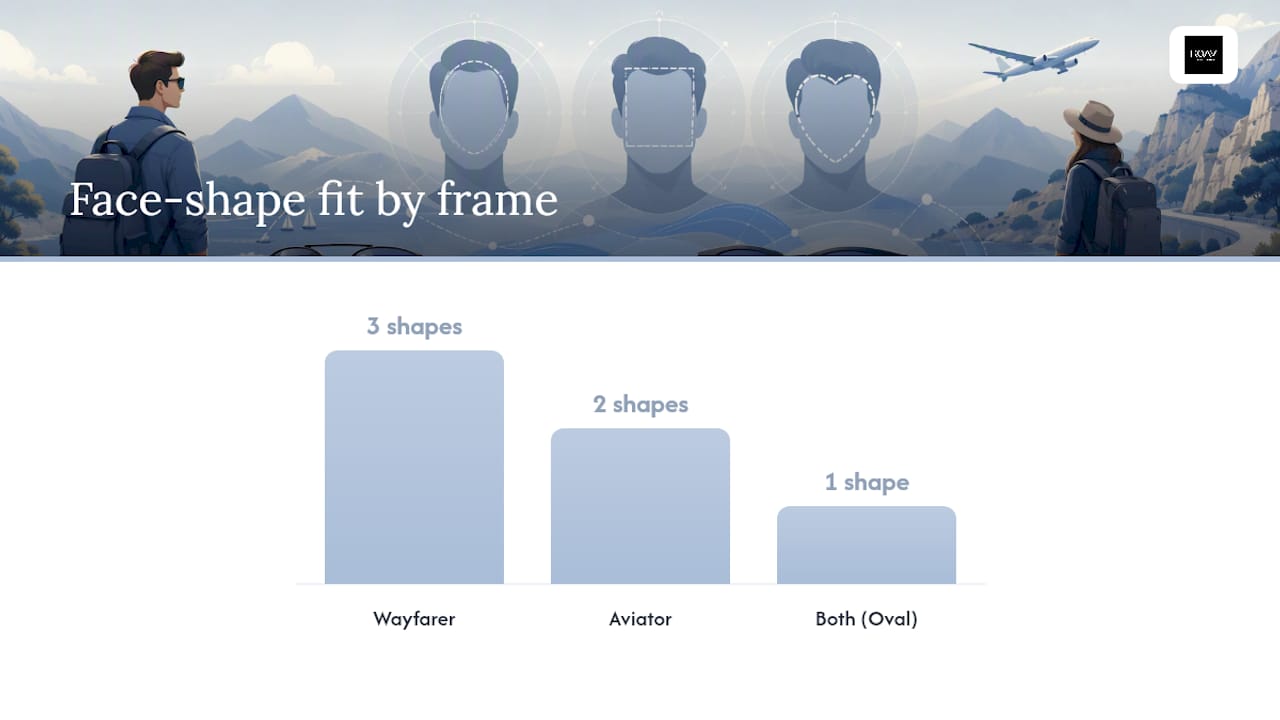
Aviators flatter square, rectangle and heart faces because their rounded teardrop lens softens angular jawlines, while wayfarers flatter round and oval faces because the trapezoid shape adds structure the face lacks, as explored in earrings that flatter your face shape fashion advice. The real trade-off comes down to fit versus coverage: aviators offer adjustable nose pads for a customizable fit, while wayfarers rely on a fixed acetate bridge that demands more precise sizing. Some brands now build both silhouettes into foldable frames, so portability no longer forces a choice.
TL;DR:
- Aviators generally provide better fit flexibility due to adjustable nose pads, making them suitable for a wider range of face shapes, especially square, heart, or rectangular faces.
- Wayfarers are more structurally suited to round and oval faces because their trapezoid shape adds definition and visual contrast to softer, rounded features.
- Foldable frames with micro hinges are available for both styles, offering practical portability without sacrificing durability or fit.
- Lens tint and UV protection are critical; neutral grey tints are ideal for everyday use, while polarized lenses are recommended for glare reduction but not for pilots.
- Proper fit, especially across the bridge and lens width, is more important than style choice for comfort and wearability, with face-shape guidance providing reliable directional advice.
Table of Contents
- Aviator vs wayfarer differences in design and construction
- Which face shape suits aviators or wayfarers?
- Aviator or wayfarer: how to style each look
- What fit and lens details actually matter day to day?
- Why the ROAV ATLAS line works for either silhouette
- Your three-step check before buying
- A note on choosing between these two
- Where to try the ATLAS collection
- Sources
- FAQ
Aviator vs wayfarer differences in design and construction
The two silhouettes are built from almost opposite design philosophies, and you can spot the difference in any product photo before you even try them on.
Aviators trace back to pilot eyewear from the 1930s: teardrop-shaped lenses, a double bridge, and thin metal frames designed to cover the eye socket completely without blocking peripheral vision in a cockpit. Wayfarers, popularized from the 1950s onward, use a trapezoid lens set into thick acetate rims with a single fixed bridge. That single structural choice changes everything else about how the glasses feel and sit.
- Frame material: Aviators typically use metal, wayfarers typically use acetate or a similar plastic composite.
- Bridge type: Aviators often have adjustable nose pads; wayfarers have a fixed bridge shaped to the frame.
- Lens coverage: Aviator lenses run larger and curve around the temple; wayfarer lenses sit flatter and end more abruptly at the frame edge.
- Weight: Metal aviators tend to feel lighter at the temple but heavier at the bridge; acetate wayfarers distribute weight more evenly across the face.
That weight distribution matters more than most buyers expect. A metal frame that pinches at the nose after three hours outdoors is a fit problem, not a style problem, which is one reason lightweight sunglasses built for everyday wear have become their own category. Foldability is another practical differentiator: a hinge that collapses the frame flat changes how these glasses travel, regardless of which silhouette you prefer.
Which face shape suits aviators or wayfarers?
Fitting guidance from optical retailers consistently maps these two silhouettes to opposite face shapes, and the logic is simple: the frame should counterbalance whatever the face’s natural lines already do.
- Oval faces suit both aviators and wayfarers almost equally, since an oval jawline has no sharp angle that needs softening or structure that needs adding.
- Round faces do better in wayfarers. The trapezoid shape and strong top line break up the roundness and add definition through the cheekbone.
- Square or rectangular faces lean aviator. The teardrop lens rounds off a strong jaw and wide temple, softening the overall look instead of doubling down on angles.
- Heart-shaped faces (wider forehead, narrower chin) also favour aviators, since the lens narrows visually toward the bottom and balances a pointed chin.
- Triangle faces (narrower forehead, wider jaw) tend to suit wayfarers with a slightly heavier top rim, which draws the eye upward and balances the wider lower half.
LensDirect’s fitting guidance backs this same square/rectangle/heart-to-aviator and round/oval-to-wayfarer mapping, and it holds up whether you’re trying frames in a mirror or scrolling a virtual try-on tool.
To check fit yourself: take a straight-on phone photo, and see whether the lens width matches your face width at the temples (not wider, not noticeably narrower). The frame should sit level, not tilted, and the bridge should rest on the nose without pinching or sliding after a minute of wear. If a wayfarer keeps riding up your nose, ask an optician about a slightly wider bridge fit rather than sizing up the whole frame, which throws off the lens-to-face ratio.
Aviator or wayfarer: how to style each look
Aviators read as sleek and a little adventurous. They’re the frame minimalists and outdoor types gravitate toward because they disappear into an outfit rather than dominate it. Wayfarers do the opposite: bold, retro-cool, and built to be noticed.
- Aviators pair well with: smart-casual blazers, travel outfits, and anything with clean, simple lines, since the frame won’t compete with the rest of the look.
- Wayfarers pair well with: streetwear, denim, and layered casual outfits where a strong graphic accessory finishes the look.
- Metal tones (gunmetal, gold, silver) on aviators shift formality up or down. Gold reads warmer and slightly dressier; matte gunmetal reads more utilitarian.
- Tortoise or matte black wayfarers lean casual; glossy black wayfarers push toward a sharper, more formal edge.
Pro Tip: If you already own a structured wayfarer, try an aviator for travel days. The lighter metal frame and rounder lens read as more relaxed against airport-casual layers, which keeps the whole outfit from looking too deliberate. For more outfit-specific pairing ideas, ROAV Eyewear’s styling guide breaks down exactly this kind of silhouette-to-outfit matching.
What fit and lens details actually matter day to day?
Bridge fit decides whether your sunglasses actually get worn or end up in a drawer after a week. Aviators with adjustable nose pads adapt to a wider range of bridge heights, which is why they tend to fit more face shapes without alteration. Wayfarers, with their fixed bridge, need more careful sizing up front since there’s no pad to nudge if the frame sits too high or slips down.
Lens tint matters just as much as shape. Eye-health guidance recommends lenses that block 100% of UVA and UVB light regardless of silhouette, since UV exposure damages the eye whether the frame is round, square, or trapezoid.
- Neutral grey tints preserve true colour and suit driving or general daily wear.
- Brown or amber tints boost contrast, useful for overcast days or variable light.
- Polarized lenses cut glare well but the FAA specifically cautions pilots and cockpit crew against them, since polarization can interact with instrument displays and laminated windscreens.
On portability: a foldable hinge that keeps the frame rigid when open reduces the scratches and lost-arm problems that come with tossing loose sunglasses into a bag.
Why the ROAV ATLAS line works for either silhouette
Some brands have built a reputation on patented micro hinges that fold a full-size frame down to pocket dimensions without weakening it, backed by large customer bases who have used that hinge through daily use and travel. Many models carry full UV protection, so the decision between aviator and wayfarer never has to compromise eye safety.
- The ATLAS Black | G15 suits a wayfarer-leaning buyer who wants a neutral, low-glare green lens for daily wear and travel.
- The ATLAS Silver | Sky suits square or heart-shaped faces looking for a lighter aviator-style finish that reads clean rather than heavy.
- The ATLAS Gold | Brown-Gradient suits round or oval faces wanting a warmer, fashion-forward tone that still folds flat for a carry-on.
Before buying, check the bridge fit against your own face shape and confirm the tint suits your main use case, whether that’s daily wear or flights.
Your three-step check before buying
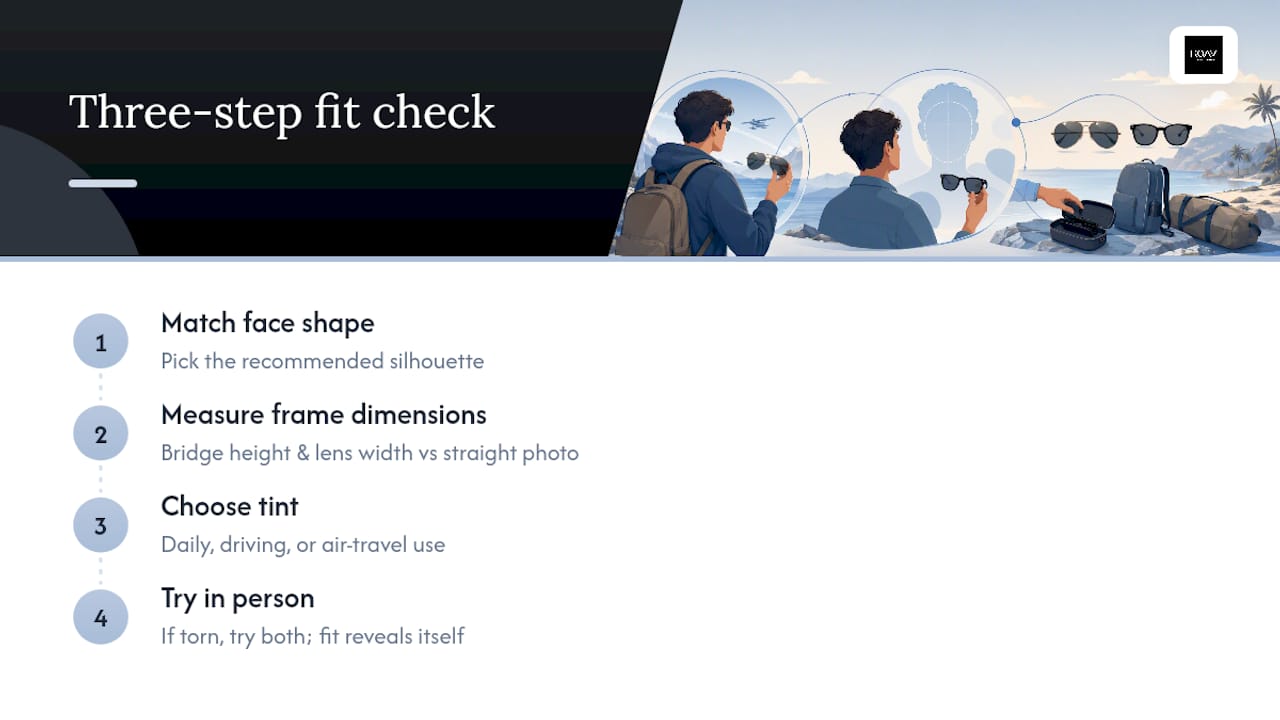
Match your face shape to the recommended silhouette, then measure your own bridge height and lens width against a straight-on photo, and finally pick a tint suited to your main use case, whether that’s daily wear, driving, or air travel. If you’re genuinely torn, try both in person. Fit reveals itself the moment you put a frame on, in a way no chart can predict.
A note on choosing between these two
Most buying guides treat this as a simple either/or decision, and that’s where they get it wrong.
I’d rather see someone buy a slightly less “perfect” frame that fits their bridge properly than a textbook match that slides down their nose by noon. Foldable construction changes that calculation in a way static frames can’t, because a frame that survives daily transport without scratching or bending gets worn far more often than one left in a drawer for fear of damaging it. That’s the practical argument for foldable eyewear, not the fashion one.
— Thomas
Where to try the ATLAS collection
Some companies built lines around a simple idea: you shouldn’t have to choose between a frame that suits your face and one that survives your actual life. Foldable designs with micro hinges fold each pair down to a size that fits a jacket pocket, so the aviator-versus-wayfarer decision comes down to fit and finish, not which one packs easier.
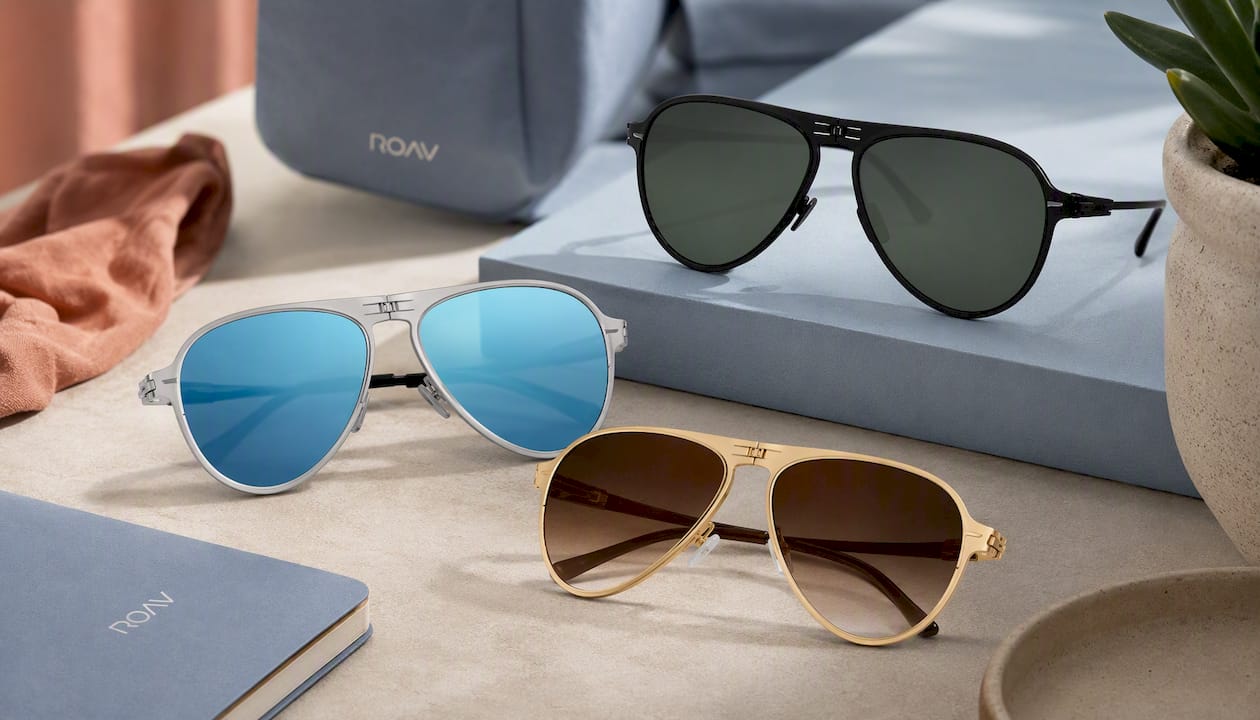
The ATLAS Black | G15 gives round and oval faces a low-glare, everyday-ready wayfarer-style option. The ATLAS Silver | Sky suits square and heart-shaped faces after a lighter, aviator-style finish for travel or daily wear. The ATLAS Gold | Brown-Gradient works well for buyers wanting a warmer tone with the same foldable build. Confirm your bridge fit and preferred tint against the face-shape guidance above, then browse the full ROAV Eyewear collection to find the pair that matches both your face and your travel bag.
Sources
For deeper detail beyond this guide: the FAA’s sunglasses brochure covers tint and polarization for pilots, the American Academy of Ophthalmology explains UV protection standards, LensDirect offers face-shape fitting rules, and the BBC’s history of aviators traces the cultural roots both styles still draw on.
- Sunglasses (FAA pilotsafetybrochures)
- Aviator vs. Wayfarer vs. Round: Which suits your face? (LensDirect blog)
FAQ
Why do pilots only wear aviators?
Pilots originally wore aviators because the large teardrop lens covered the entire eye socket against high-altitude glare without blocking peripheral vision, a need documented in FAA safety guidance on cockpit eyewear.
What type of person wears aviators?
Aviators suit people with square, rectangular, or heart-shaped faces, and they tend to appeal to minimalists and outdoor-oriented buyers who want a frame that reads sleek rather than statement-making.
Are aviators outdated?
No. Aviators have shifted from purely functional pilot gear to a mainstream fashion staple, and they remain one of the two most requested silhouettes in eyewear fitting guides today.
Are Ray-Ban aviators still cool?
Classic aviator styling remains culturally relevant decades after its original release, largely because the shape flatters a wide range of face shapes rather than depending on any one brand or trend cycle.
Should I choose an aviator or wayfarer for travel?
For travel, prioritize a foldable frame over silhouette first. Compact foldable models in either aviator or wayfarer styling protect the lens and hinge in a bag far better than a rigid, non-folding frame.